On May 2, 1878 there was an explosion of the flouring mills at Minneapolis, Minnesota at the Washburn A Mill. 18 workers were killed in the explosion, 14 of them killed instantly. The force of the explosion blew the mill’s concrete roof several hundred feet into the air. It leveled the 7 1/2 story limestone building. As a result of the explosion, the Humboldt and Diamond Mills were also flattened. Evidence investigated after the loss indicated that the Washburn A Mill exploded first, and the force of the explosion hit each of the other mills sequentially. The mill was originally built in 1874 and was declared the largest flour mill in the world. The Washburn A Mill was reconstructed in 1879. At peak production, the Washburn A Mill could grind over 100 boxcars of wheat, almost 2 million pounds of flour per day using 41 grinding stones. A monument to the 18 workers killed in the explosion was erected in 1885 in the Lakewood Cemetery. The inscription on the monument reads, “Labor wide as the earth has its summit in heaven.”
Washburn A Mill Flour Explosion May 2, 1878
May 2, 2011
 Leave a Comment » |
  Uncategorized | Tagged: dust explosion, explosion, flour, flour mill, Minneapolis |
  Permalink
 Posted by Walt Beattie
Combustion safety switches on boilers & furnaces
April 25, 2011
When was the last time you consciously looked at and inspected the supervisory switches on your boilers and furnaces? When I visit a facility, I try to look at them whenever I walk by them. Sometimes, more times than I should, I find that the low pressure supervisory switch and the high pressure supervisory switch on the natural gas combustion train are pegged to the minimum position on the low pressure switch, and maximum position on the high-pressure switch. Occasionally I will also note other controls, such as the high-pressure cutout switch which is designed to shut the boiler down if the pressure exceeds safe pressure limits is not properly set.
Chances are that the boiler being protected by this switch with this setting will never shut down if the gas pressure falls below safe limits.
During normal operations, your fired equipment (your boiler or furnace) will operate normally for long periods of time, sometimes many months. During these times of smooth operation operators may become lax and may not perform the checks they should be doing on a regular basis. The disabling of safety devices, such as the high and low gas pressure supervisory switches, may lead to catastrophic results. Safety devices and combustion controls are installed for your safety and the safety of your employees. These devices are required because history has proven that they are needed, they can prevent catastrophic events, and they can save lives.
I urge you to implement a combustion safety program at your facility, and perform safety checks and calibrations of all safety devices on at least an annual basis.
Leave a Comment » | Uncategorized | Tagged: combustion safeguards, Honeywell Gas A/G/LP pressure switch, Honeywell Gas A/G/LP pressure switch; combustion safeguards, low gas pressure supervisory switch, natural gas combustion safeguards | Permalink
Posted by Walt Beattie
Dry Standpipe System Inlet
April 17, 2011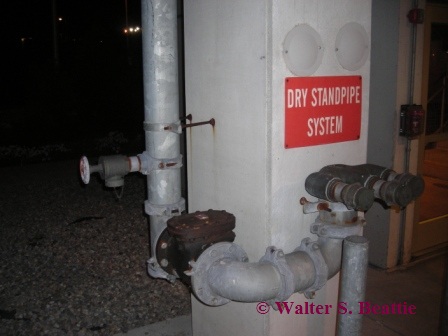
Dry Standpipe inlet for Fire Department use
Dry standpipes are an economical method to provide water supplies to areas which fire engines cannot access. This Dry Standpipe is located at the parking garage of an airport. A fire engine will pump water into the inlet fittings. The swing-clapper type check valve allows the water to enter into the piping and prevents it from draining out when the hoses are removed. A low point drain prevents water from standing in the pipes and freezing in the winter. Fire departments should have a written operating procedures for using these systems.
Leave a Comment » | Uncategorized | Tagged: Dry standpipe, fire department connection, fire department inlet, parking garage standpipe, pumper inlet | Permalink
Posted by Walt Beattie
Hydrant flushing should be performed annually
April 13, 2011
Yard hydrants should be operated annually and flowed until all foreign material has cleared.
This is a yard hydrant which had not been flushed for many years. This hydrant has been flowing for 3 to 4 minutes when this picture was taken, and the water is still brown. Yard hydrants should be operated and flushed on an annual basis. Each hydrant in your fire system should be opened fully and flowed until all foreign material has cleared, but for not less than one minute. A good flushing to remove silt and particulate matter should be performed annually to clear the underground pipes of debris.
Leave a Comment » | Uncategorized | Tagged: flushing hydrants, hydrant flushing, Hydrants, operating hydrants, private hydrants, sediment, Yard hydrants, Yard mains | Permalink
Posted by Walt Beattie
Would you bet your life on this sprinkler head?
March 30, 2011
Would you bet your life on this sprinkler head?
This sprinkler head was in a hotel room in which I stayed. The painters painted the deflector, and got paint on the fusible link, orifice, and frame. This head should be replaced.
Leave a Comment » | Uncategorized | Tagged: damaged sprinkler head, hotel sprinkler, painted deflector, painted sprinkler head, quick response, sprinkler | Permalink
Posted by Walt Beattie
Water mist sprinkler head on a cruise ship
February 24, 2011
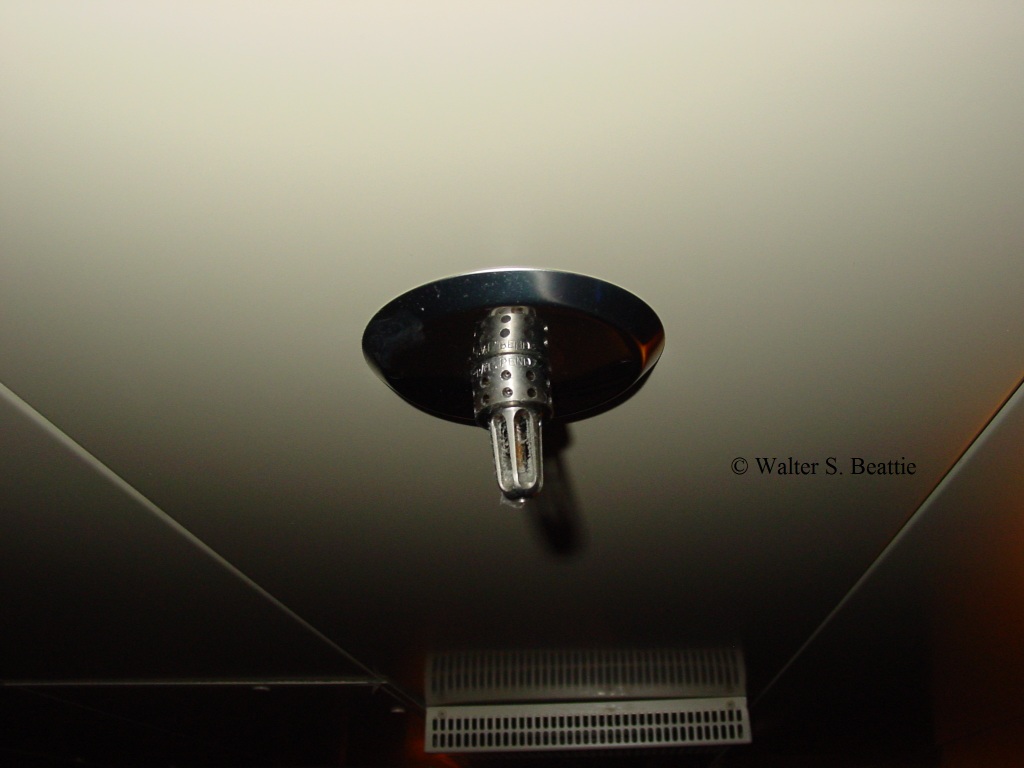
Water mist sprinkler head on a cruise ship
Hi-Fog systems are used in shipboard fire protection systems. These heads deliver a low volume, high velocity discharge mist of water which will control or extinguish a fire in the enclosure. These nozzles may also be installed to protect the laundry, galley ducts, as well as the deep fat fryers in kitchens. This head is believed to be a Hi-Fog 1000 head manufactured by Marioff. This head will have a strainer in the base to help prevent it from becoming clogged.
Leave a Comment » | Uncategorized | Tagged: fire protection on cruise ship, Hi-Fog, Hi-Fog 1000, water mist | Permalink
Posted by Walt Beattie
Steam underwriters pump
February 20, 2011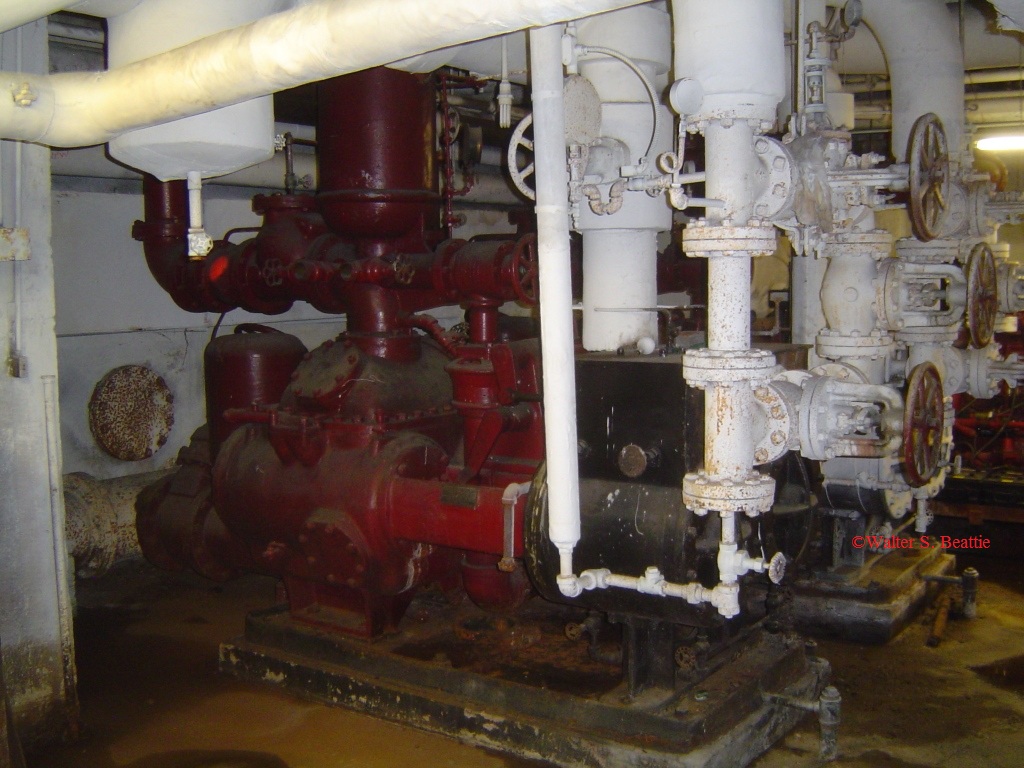
This is a Steam Underwriters Pump. They were the mainstay of fire protection pumps at the turn of the last century. Today, these pumps are not longer recognized for fire service. Today, plants do not typically maintain a reliable head of steam to operate these pumps.
Leave a Comment » | Uncategorized | Permalink
Posted by Walt Beattie
Best Practices in Fire Safety – Virtual Symposium
February 13, 2011
I would like to invite you to attend ASSE’s Best Practices in Fire Safety – Virtual Symposium
Live. Online. On-Demand.
March 1 & 2, 2011
Complete the entire 2-day Virtual Symposium by attending the live webcasts or view the recordings of the sessions ANYTIME/ANYWHERE for up to 30 days after the symposium ends. Earn 1.6 CEU’s.
To register, or to learn more, go to http://www.asse.org/education/firesafety/
Take advantage of the early registration discount by February 18, 2011.
SCHEDULE OF SESSIONS
Tuesday, March 1st
9am Opening General Session – Review of NFPA 101, Craig Schroll, President, FIRECON
11am Techniques for Hazard Recognition for the Field Employee, David F. Coble, CSP, President, Coble, Taylor & Jones Safety Associates LLC
1pm The Fire Prevention Plan, Another Type of Hazard Analysis, Gabriel F. Miehl, CSP, CFPS, GE Transportation, Erie, PA
3pm Is Your Sprinkler System Giving you a False Sense of Security? Walter S. Beattie, CSP, CFPS, CSHM, AXA Matrix Risk Consultants, Pottstown, PA
Wednesday, March 2nd
9am Predictive Maintenance Integration for Electrical Distribution Safety & Reliability, Dale P. Smith, CMRP, Corporate Programs Manager, Predictive Service
11am Management Programs to Help Prevent Dust Explosions, Ron Allen
1pm Combustion Safety, Jason Safarz, Senior Account Engineer, CEC Combustion Services Group
3pm What Every Safety Professional Needs to Know About Automatic Sprinklers, Jacob Epstein, Associate Consultant, Aon Risk Solutions, Global Risk Consulting, Fire Protection Engineering
Best Practices in Fire Safety – Virtual Symposium
Live. Online. On-Demand.
Leave a Comment » | Uncategorized | Tagged: ASSE, Automatic Sprinklers, Best Practices in Fire Safety, Combustion Safety, Craig Schroll, Dale P. Smith, David F. Coble, Electrical Distribution Safety & Reliability, Fire Prevention Plan, Fire Sprinkler System, Gabriel F. Miehl, Hazard Recognition, Jacob Epstein, Jason Safarz, NFPA 101, Predictive Maintenance Integration, Prevent Dust Explosions, Ron Allen, Virtual Symposium | Permalink
Posted by Walt Beattie
The Beginning Of Safety Engineering As We Know It
February 6, 2011Recently, I was asked to write about a historical aspect of fire protection and safety engineering for the Fireline, a publication of ASSE’s Fire Protection Practice Specialty. This is a synopsis of some of the information from that article and research.
Insurance engineers go back to the early 1800’s. In 1835, Zachariah Allen, a textile mill owner made property conservation improvements to his property that would help them minimize the fire hazard. At that time, he approached his insurance company for a rate reduction, and was denied. This was the formation of the highly protected risk (HPR) mutual insurance companies. Over the next 20 years, more mutual insurance companies were founded, and they joined forces to provide additional capacity for losses. These companies involved into the Associated Factory Mutual Fire Insurance Companies, or as they became known, the Factory Mutuals.
Each of these companies employed loss prevention engineer’s. By 1878, the Factory Mutuals established a dedicated unit of engineers to inspect insureds facilities. Factory Mutual (FM) began testing products in 1886. FM also had follow-up inspections at manufacturers, and, like UL, investigated failures of equipment and installations.
In 1890, about a dozen stock insurance companies join forces to write insurance for factories with too much hazard in value for any one of them to handle on their own. This was the Factory Insurance Association (FIA). The FIA maintained a dedicated group of engineers to travel the country to inspect insured facilities.
In the late 1800s, safety engineering was so prevalent that weekly newspapers was published by insurance interests under the title “Insurance Engineering.” Prior to 1913, Insurance Engineering was renamed Safety Engineering. “The Standard – A Weekly Insurance Newspaper” was another magazine which regularly had articles about safety, mostly on the fire side. At that time, most safety engineering was performed by engineers. Safety engineering in the early 1900s was an independent branch of social science which was contributed to by an increasing number of research laboratories. These laboratories are maintained by manufacturing facilities, as well as insurance company supported laboratories. During the late 1800s, the factory mutual was one of the leading sources of fire protection technology, testing, and approvals area this information was developed primarily for their shorts. Prior to 1900, stock insurance company underwriters would individually decide which fire protection equipment, and equipment arrangements they would accept.
One of the big steps towards early safety engineering and laboratory testing was at the 1893 World’s Columbian Exposition in Chicago. People were amazed by the spectacular vision of 100,000 Edison light bulbs area at this exhibition, fires kept breaking out, igniting the combustible building covering. Chicago fire insurance authorities were concerned about the network of electrical wires, and their connections, and the new alternating current. In response, William Henry Merrill, an electrical inspector, set up a laboratory near the fairgrounds, above the Fire Insurance Patrol Station Number One. This one-room laboratory was furnished with a bench, table, chairs, and a few electrical measuring devices purchased for the sum of $350. The Chicago Board of Fire Underwriters in the Western Insurance Association provided financial backing, and the Laboratory Became The Underwriters Electrical Bureau.
In 1900, the laboratory moved into larger quarters, and in 1901 it was chartered as Underwriters laboratories, Inc. Its new sponsor, the National Board of Fire Underwriters was the basis for the new name.
Insurance company offices were typically located in major cities around the US. Fire protection engineers were assigned to an office, but some, even going back to the early 1900’s were located geographically around the country. They would handle the work around their towns, and travel as needed to more remote areas. I recall speaking with older engineers who had retired from FIA, some of whom followed in their father’s footsteps. They related that the early engineers would travel mostly by train to a town and be met by a plant employee who would provide transportation to the factory. Trips in those days could be long, and in some cases it would be weeks before the engineer returned home.
Based upon my own personal research, I believe the current profession of safety engineering evolved from the fire protection engineers of the 1800s. Fire protection engineers had a huge head start in the safety engineering field due to the financial ramifications of fire. Workers compensation, liability insurance, and other safety aspects developed later in time. When the American Society of Safety Engineers was founded in 1911, the impetus was a fire related event in which there was loss of life.
I also believe that the aviation industry in the maritime industry drove safety engineering. Maritime safety is evident hundreds of years ago. Ship owners, and maritime underwriters had a vested interest in the safe arrival of ships and goods. While the driving force was not employee related, sailors were a valuable commodity on the ships, where there were no quick replacements. In the aviation industry, a failure typically resulted in a crash and loss of life. The military drove safety engineering, and, more recently, fault tree type analysis of which Willy Hammer wrote in his book.
The military also implemented safety engineering hundreds of years ago. In colonial Williamsburg, some of the discussions that I attended were regarding the safety of the powder magazine, and why it was located away from other buildings. Even during the Revolutionary war, there were special precautions in place for the handling of black powder and munitions. At that time, the practice was not referred to as safety engineering, but in my mind that’s what was.
In celebration of ASSE’s 100th anniversary, the Fire Protection Practice Specialty has dedicated its first issue of the year to historical aspects of fire. An article about the evolution of the fire sprinkler discusses many of the items listed above. Much of the information mentioned here is from that article, and related research. Fire protection practice specialty members will receive the entire publication within the next few weeks.
For more information, check out this article: Evolution of the Fire Sprinkler
©Walter S. Beattie
Leave a Comment » | Uncategorized | Tagged: 1893 World’s Columbian Exposition, American Society of Safety Engineers, ASSE, Factory Insurance Association, Factory Mutual, FIA, Fire protection engineers, Fire Protection Practice Specialty, Insurance Engineering, Insurance engineers, National Board of Fire Underwriters, Safety engineering, The Standard - A Weekly Insurance Newspaper, William Henry Merrill | Permalink
Posted by Walt Beattie
Viking High Challenge 280°F 0.64 Orifice Sprinkler Head
January 20, 2011
In the 1970′s, Factory Mutual conducted many tests in an effort to meet the growing fire challenges from the ever more hazardous warehousing commodities and configurations. An early solution was the High Challenge Sprinkler Head. This head is a Viking High Challenge 280°F 0.64 Orifice Sprinkler Head. It produced a larger water droplet which better penetrated through the fire in racks to reach the seat of the fire.
Leave a Comment » | Uncategorized | Tagged: 0.64 Orifice Sprinkler Head, High Challenge, storage, Viking | Permalink
Posted by Walt Beattie
 WaltBeattie.com