ASSE Helps Provide Fire Prevention Training for Students

January 21, 2012
Campus Fire Safety

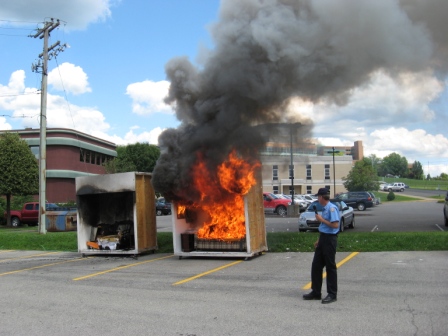
Campus Fire Training - Demo burn of a dorm room

Each year, college students are injured and killed in preventable campus-related fires. To prevent injuries and fatalities caused by fires that occur in college residence halls, off-campus housing and fraternity/sorority houses and to raise awareness about life-saving fire prevention knowledge as students head back to school, ASSE, West Virginia University (WVU), RA Fire Academy and the Morgantown Fire Department are providing key fire prevention information and demonstrations.

According to NFPA, from 2000 to the present, 146 students have died in a combination of off-campus, residence hall and fraternity/sorority fires. The majority of campus-related fatal fires occur in off-campus housing. According to the U.S. Fire Administration, of the 146 campus-related fire fatalities that occurred from January 2000 to the present, 85% happened off campus. Today, more than two-thirds of the U.S. student population lives in off-campus housing.

WVU’s Department of Environmental Health and Safety (EH&S) recognized the importance of having a strong, vibrant fire safety program. The RA Fire Academy evolved out of several training sessions the department offered for the students, campus community and local high schools in the area. By working collaboratively with various university departments, administrators, student staff and the Morgantown Fire Department, the RA Fire Academy was created. Some form of this fire safety training has been offered since 2003 to students in the campus community. WVU EH&S envisions offering this fire academy training to all first-year students.

All student RAs are required to participate in the RA Fire Academy in a variety of hands-on training scenarios. The RAs then share the information they learn with the students on their respective floors. Activities include:

•  smoke-filled hallway

•  hands-on fire extinguisher training

•  quizdom training

•  movie/lecture

•  competition games [Skeet Shoot Frisbee (shoot Frisbee from the air) and Medicine Ball Push (push ball with fire hose to a designated distance)]

•  live burn (A mock dormitory room is constructed with the appropriate early warning fire protection. The room is then set ablaze. Students observe how quickly a room is engulfed with smoke and flames; and, they learn the importance of smoke detectors, evacuation and sprinkler systems. Additionally, the importance of using open flames with caution is discussed.).

Each RA rotates through each training station. The training culminates in the sixth station where a dorm room mockup is lit, and students are able to see just how quickly a dorm room fire can spread. The overall goal is to provide each RA a rounded training session.

The RA Fire Academy is intended to provide student leaders with the necessary knowledge and skills to better enable them to assist others in the event of an actual fire emergency on campus. The goal is to give them some real life hands-on experience in a safe and controlled setting so if they are ever faced with a real fire emergency, they will have the confidence to make the right decisions in a quick, calm way and hopefully save lives.

See the article by John A. Principe III CSP, CHCM & Walter S. Beattie, CSP, CFPS, CSHM: ASSE Helps Provide Fire Prevention Training for Students


Emergency Gas Shut-off Valves

January 21, 2012

An earthquake actuated gas shutoff valve installed on a gas line will go a long way to reducing the fire following earthquake risk at your facility.

During an earthquake, one of the most serious threats to your facility is from natural gas. During an earthquake your entire building shakes. The pipes in your building are under stress. They will shake and may break at the fittings. Whatever is contained within the pipes will leak, whether the material is sprinkler water, process gas, compressed gas, or natural gas. This is why earthquake bracing is required in earthquake subject areas.

If your gas line is broken inside your facility it will usually find an ignition source. The ignition source may be from broken wiring, pilot lights, or heat sources. If the gas supply is not immediately shut down, gas could flow uncontrolled from the broken pipe, feeding a fire within your facility. This condition is sometimes called a “Fire Following Earthquake” fire. The municipal fire department and emergency responders are going to be responding to the most immediate life safety crisis. That may be a bridge, the grade school, or a hospital or nursing home collapse. Emergency resources will be expended first at locations which pose the greatest life safety risks. Property emergencies will take a secondary response priority during an earthquake.

An earthquake actuated gas shutoff valve or an excess flow valve (EFV) will go a long way to reducing the fire risk at your facility. The device should be UL listed and/or FM Approved. The purpose of the devices is to shut down the gas flow in the event of a broken pipe. Each operates slightly differently. Each of these valves are available in various sizes, typically from 3/4 inch residential size to 8 inch industrial size. Most valves may be installed by any competent plumber or maintenance person.

An earthquake actuated gas shutoff valve has a ball on a post. When the ball is properly balance on the post, the gas will flow normally. When an earthquake shakes the valve, the ball will flop off the post, and the valve will immediately close in the fully shut position.

An excess flow valve will sense a larger than normal flow, and will shut down automatically. These valves will operate with not only an earthquake, but any pipe breakage. If one of your forklift operators goes too high and hits and breaks the natural gas pipe, the excess flow will immediate shut off the gas flow at the source. The excess flow valve works by placing a movable spring loaded plug within a restricted area of the valve pipeline. The plug sits in the pipe and allows gas to flow around it. If there is flow of gas beyond the flow limits of the system, or an excess flow of gas, the plug will be swept up and will plug itself against a gas shutoff seat. This will shut down the flow of gas. Some valves are spring loaded so that after repairs, the spring will allow the plug to return to its normal position. EFV’s may also be installed underground, such as at the entrance to your property. The valve will also help protect against excess flow from physical damage, such as your gas line being struck and severed by a backhoe or digging machine.

Each of these valves may be used for various gases. If you have an industrial process with a flammable or anesthetic gas, each of these valves may be employed as a safety device.

Check with your local gas provider or building code enforcement department to ensure the valves are properly installed.

Remember, once one of these devices operate, all the pilot lines will go out. You must not reset the device or turn the gas back on until the gas company or other qualified person inspects, repairs, and relights each pilot line.


Happy Holidays!

December 20, 2011


The Second Great Chelsea Fire: October 14, 1973

October 14, 2011

The first great Chelsea, MA fire was on April 12, 1908. Over 2800 buildings were destroyed. The fire began at the Atwood and McManus Box Company on Everett Ave. at the Vale Street. Wind carried the burning embers to other buildings. There were four fatalities, many injuries, and 10,000 people were left homeless. Most of the buildings in the area were of cheap wooden construction. 13 churches, to hospitals, the public library, the City Hall, five schools, 20 blocks filled with businesses, and 300 residences were destroyed.

Move forward to October 14, 1973. The second conflagration to hit Chelsea struck within hundreds of feet of the first conflagration of 1908. The area was dilapidated and under an urban renewal plan. The rag shop district was to be converted into a modern industrial park. 39 buildings had been vacated, but not yet demolished. Some of the buildings held product which was not salable. Again, wind was a major factor in spreading the fire. By the end of the fire, 18 city blocks, 45 acres, and an area 1 mile long and 1/2 mile wide were destroyed. Fortunately, there were no reported fatalities.

Throughout history there are many examples of recurring fires. Perhaps not in the same city, but in the same type occupancy. Nightclubs, theaters, hotels, and residences are some of the occupancies jump forward in my mind when I think of recurring fires, particularly when I think of loss of life.

Our fire codes and standards are developed as a result of major fire losses. Many lives have been lost, many people have been injured, and many people have been tragically touched as a result of these fire incidents. One of the greatest defenders against fire is the automatic sprinkler system. Today in the United States, our hotels, hospitals, nightclubs, and other assembly occupancies are predominately sprinkler protected. Our next great challenge is the sprinkler protection of all private residences. Almost 40 years ago, in 1973, the presidentially appointed National Commission on Fire Prevention and Control published America Burning. The report stated that we should be using new technology, such as sprinkler protection, to protect our country from the ravages of fire.

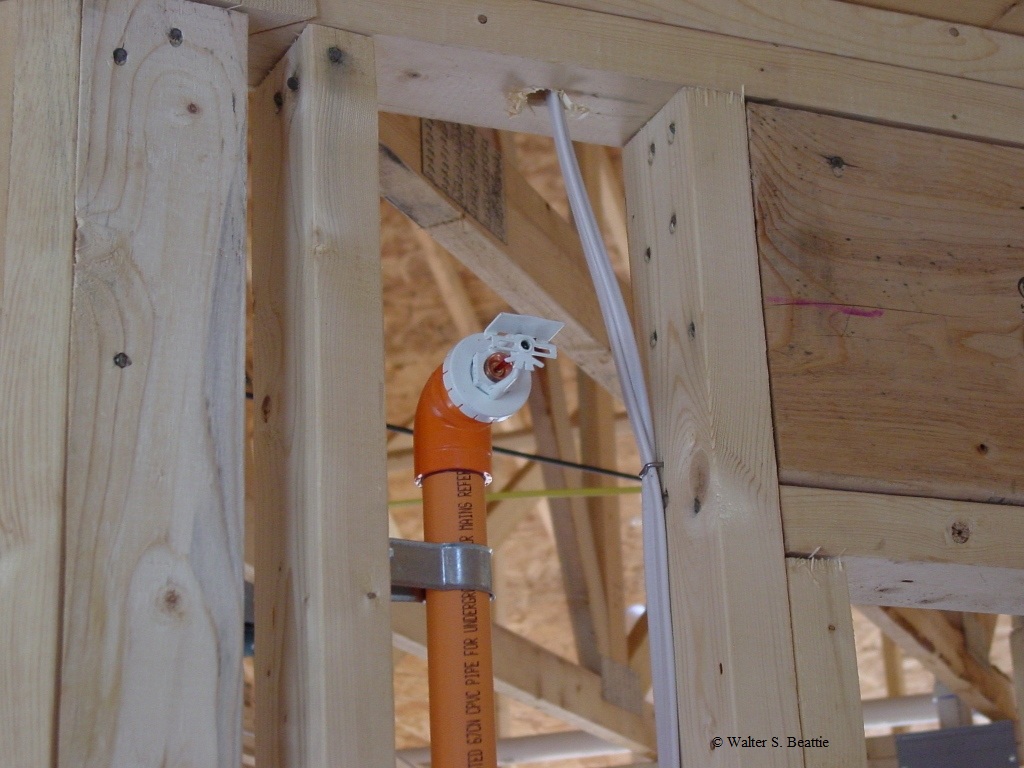
A Fire Sprinkler in a Residence Under Construction

In terms of the residential fire problem, the statistics have changed, but the problem continues to exist. According to the United States Fire Administration, An estimated 374,900 residential building fires are reported to U.S. fire departments each year and cause an estimated 2,630 deaths, 13,075 injuries, and $7.6 billion in property loss (2009 statistics). Forty-six percent of nonconfined residential building fires extend beyond the room of origin. Smoke alarms were not present in 21 percent of the larger, nonconfined fires in occupied residential buildings.

The fire service is making progress by endorsing ordinances which require automatic sprinkler protection in all new residential construction. Unfortunately, many of our lawmakers who have sworn to protect us are falling short when it comes to ordinances requiring fire sprinklers. In Pennsylvania, a state law was passed to require automatic sprinklers in all new residential construction. Unfortunately, our lawmakers kowtowed to the construction lobbyists which help fund their reelection coffers. The law to require sprinklers in residential structures was recently repealed, opening the door to additional future residential fire deaths in Pennsylvania.

When is our society going to wake up to the fire hazards in our communities? When is our society going to take a proactive stance against fire deaths in our communities? Until we are personally touched by the catastrophe of fire, fire is another person’s problem, not ours.

Insanity: doing the same thing over and over again and expecting different results – Einstein


Liquid Storage Tank Protection

August 1, 2011

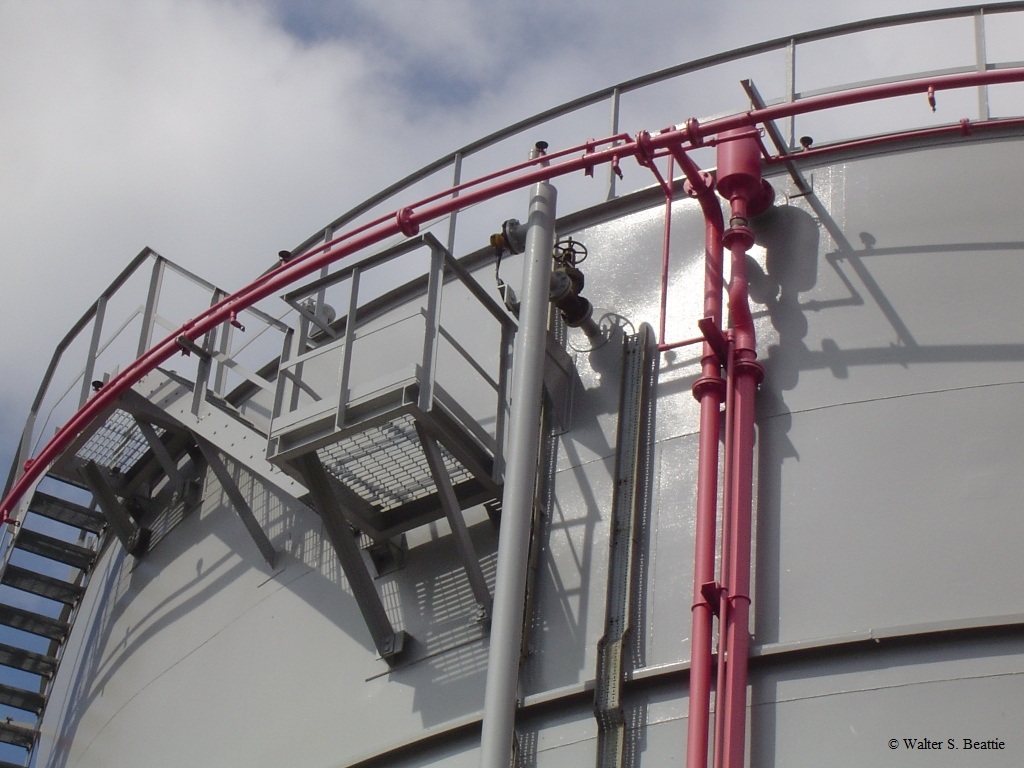
Liquid Storage Tank Foam Protection

This tank stores combustible and/or flammable liquid material. Protection is provided with both interior and exterior protection. The exterior protection for the tank is provided with a ring(s) of piping which feeds open head directional sprinklers. These sprinklers may spray foam solution which has been mixed at the deluge valve, or it may spray water only. The detection is a ring(s) of sprinkler heads which are installed on a pilot line. When a sprinkler head fuses, the air pressure within the piping is released, and a deluge valve is actuated. When the deluge valve operates, water flows through the piping to the open sprinkler heads which are directed onto the sides of the tank.

There is also interior foam application installed in this tank. The application device consists of an air aspirating foam expansion chamber and an integral foam maker. This style is referred to as a “Type II” top-side application device.  The foam chamber is installed above the highest level of product storage. The foam concentrate is mixed into a foam solution in an area which is outside of the hazard area, and then travels to the expansion chamber. The foam expands, is discharged against a deflector plate inside the tank, and is then gently delivered onto the surface of the liquid. Flow rates are sized for each specific tank.


ASSE Safety 2011 Exposition took place June 12-15, 2011 at McCormick Place West

June 19, 2011

ASSE Safety 2011 Exposition took place June 12-15, 2011 at McCormick Place West in Chicago, Illinois. Thousands of people from more than 40 countries poured into Chicago for the American Society of Safety Engineers’ Professional Development Conference (PDC) and Exposition held at McCormick Place Convention Center The Conference set an all –time record high for both attendance and the expo. ASSE celebrated its 100th anniversary. There were a record setting 4,503 attendees at the ASSE 2011 PDC in Chicago setting an all time record. This was ASSE’s largest expo ever featuring 475 exhibitors and selling 75,000 square feet.

I am proud to have been a part of the event as ASSE’s Administrator of the Fire Protection Practice Specialty. The Fire Protection Practice Specialty had a glowing presence at the PDC, featuring a Practice Specialty Kiosk in the exhibition hall. The Fire Protection Practice Specialty also hosted, sponsored, and participated in several events. Our annual meeting, was held at Giordanos Restaurant, 135 E Lake St, Chicago. There were several sponsored technical sessions, and members attended many meetings, such as the Council on Practice Specialties, House of Delegates, Student Round table, and networked with many other attendees.


TV photographer’s view of Utica, New York fire that killed four & complaints that not enough was done.

May 10, 2011

Heartbreak on Schuyler Street, through a photographer\’s lens

My heartfelt sympathy goes out to the family and friends of the victims of the Utica, NY fire which occurred at a residence on Schuyler Street on Monday, May 9, 2011. A mother and three young children lost their lives in the fire.

WKTV News Channel 2, Utica, NY posted a heart wrenching video created by Mr. Tim Fisher, a WKTV-TV photojournalist about a fire that occurred on Monday, May 9, 2011 at about 9:30 am in Utica New York. The fire took the lives of a mother and her three young children. Some family and friends were critical of the Utica FD response and their actions at the fire. They did not feel the fire department tried hard enough to find and rescue the four who died.

Those who have read my blogs, articles, and administrator messages in Fireline know that fatal fires happen all too often. I have tried to highlight loss lessons to remind us that these fires are still occurring. Some builders and realtors talk about the minimal cost of adding sprinklers into the construction of a new home as being unreasonable, that this small cost to save lives will somehow interfere with their efforts to get rich. I look at the conscious efforts to prevent future losses like this from happening an unconscionable, and urge everyone to step up and send a message to their legislators that fire sprinklers save lives, property and livelihoods.

Thanks to Mr. Fisher and WKTV News 2 for creating this video. It will be a video that will live on for many years to come. http://www.wktv.com/news/local/121577954.html

Thanks to Dave Statter http://statter911.com and http://www.FireFighterCloseCalls.com for their efforts to advertise this video on their web sites and in their e-mail blasts in an effort to bring this to the fire service community.


ASSE’s 100th Anniversary

May 5, 2011

ASSE’s 100th Anniversary from jon schwerman on Vimeo.

The American Society of Safety Engineers is celebrating its 100th Anniversary in 2011. Founded in 1911 as the United Association of Casualty Inspectors, the Society was formed in the wake of tragic events such as the March 25, 1911, Triangle Shirtwaist Factory Fire in New York City where 146 young girls and women lost their lives in a workplace tragedy that drew the attention to the need for workplace safeguards and regulations.


Arson Awareness Week is May 1-7, 2011

May 4, 2011

The United States Fire Administration (USFA) is pleased to partner with the International Association of Arson Investigators; Bureau of Alcohol, Tobacco, Firearms and Explosives; USAonWatch; National Association of State Fire Marshals; National Volunteer Fire Council; and the Insurance Committee for Arson Control to announce the theme for the 2011 Arson Awareness Week: Working Together to Extinguish Serial Arson. USFA and its partners will use the week of May 1st to the 7th to focus public attention on the value of a collaborative effort with law enforcement, fire and emergency service departments, and the community to battle serial arsonists.

The Bureau of Alcohol, Tobacco, Firearms and Explosives (ATF) reports that from 2009 – 2010 there were 88 reported serial arson incidents with an aggregate monetary loss of $4.8 million. Arson in residential dwellings accounted for 49 percent of these incidents. The National Fire Protection Association reports that in 2007, three firefighters died and 6,100 were injured during response to intentionally set fires.

According to the USFA’s National Fire Incident Report­ing System (NFIRS) data, from 2004 to 2006 an estimated 210,300 intentionally set fires occurred each year in the United States. Intentionally set fires account for 13 percent of fires responded to by fire departments across the Nation. These fires resulted in an average of approximately 375 deaths, 1,300 injuries, and $1.06 billion in property loss each year.

For more information regarding the 2011 Arson Awareness Week, go to
http://www.usfa.fema.gov/aaw/

View the press release at
http://www.usfa.dhs.gov/media/press/2011releases/033111.shtm

The United States Fire Administration recommends everyone should have a comprehensive fire protection plan that includes smoke alarms, residential sprinklers, and practicing a home fire escape plan.


The Hindenburg Disaster

May 3, 2011

The Hindenburg disaster took place on Thursday, May 6, 1937. The German lighter-than-air, rigid frame, passenger airship LZ 129 Hindenburg left Frankfurt Germany on the evening of May 3. At approximately 7:00 pm, May 6, 1937, it approached Lakehurst Naval Air Station, NJ adjacent to the borough of Lakehurst, New Jersey. Of the 97 people on board, 35 people died. In addition, another person was killed on the ground. The actual cause of the fire remains unknown. There were many hypotheses, but none proven. This crash was the deathblow to the rigid frame lighter-than-air airship era.

The Hindenburg was originally designed to use helium gas. Due to a US embargo on the exportation of helium prior to WWII, hydrogen was used to make the airship buoyant. Hydrogen is extremely flammable and burns intensely in air. As a result of the Hindenburg fire, hydrogen was banned from being used in this application.

Airships are no longer used for passenger transport, but they are used for advertising, sightseeing, surveillance and research. The Goodyear Blimp is a fixture over key football games.