Iroquois Theatre Fire – December 30, 1903

December 29, 2010

The Iroquois Theatre fire occurred on December 30, 1903, in Chicago, Illinois. It is the deadliest theater fire in United States history. Over 600 people died as a result of the fire, and it is believed that not all the deaths were reported.

The Iroquois Theater had just opened on November 23, 1903, and was touted as being absolutely “FIREPROOF!” An asbestos fire curtain was installed to isolate the stage from the audience. Despite the warnings of fire officials and engineers, the show went on. The roof over the stage was nailed shut, many of the fire exits reportedly did not have working stairs to the ground, there were no exit signs, exit routes from the balconies were complicated, and there were no exit route signs installed. The asbestos fire curtain at the stage was reported to be of flimsy material which burned to a crisp in the fire. There were no fire drills conducted by the theater for ushers and employees. When the fire broke out, they did not have adequate training and knowledge of what they should do in a fire!

The capacity of the theater was 1,724, but the crowd that night is expected to have far exceeded the rated capacity. On December 30, 1903, during the second act, a light sputtered and a piece of machinery caught fire. The electrician could not pot the fire out, but the performers continued with the show. Back doors were opened, which created an influx of oxygen to feed the fire.

In a all too familiar scene, people were trampled to death in the onslaught of panicking patrons trying to exit the building. Stairs had been blocked and locked with gates, preventing patrons to exit. Several exit doors had been locked to prevent outsiders from slipping in without playing.

After the fire, Carl Prinzler, a salesman for Vonnegut Hardware Company, Indianapolis realized that he was to have been at the performance that day, and a stroke of fate prevented him from going. He became obsessed with the tragedy, and eventually developed a new device in collaboration with Henry DuPont, an engineer: The Crash Bar. The patent was awarded in 1908. Today, variations of the Crash Bar are required on all exit doors of public buildings.

New codes were implemented across the nation for theaters and exiting in all public buildings. Unfortunately, new codes take time to implement. Unfortunately, building owners and managers refuse to learn from the lessons of the past in an effort to meet a personal goal or agenda. These type tragedies would continue. A few years later, some of these same lessons were repeated at another high-profile fire: The Triangle Shirtwaist Fire of March 25 1911.

Watch for the upcoming edition of ASSE Fireline for an in-depth article titled “Carl Prinzler’s Invention and The Iroquois Theater Fire” by Trevor Simon.


Chicago Fire Fatalities

December 22, 2010

Media sources in Chicago are reporting two firefighters have died from injuries at a three alarm fire this morning (December 22, 2010). Other firefighters are injured.  Our thoughts and prayers go out to the families and friends of those involved and the CFD. This is yet another tragic event in the fire service history.

As fate might have it… December 22 is also the anniversary of the 1910 fire at Union Stock Yard & Transit Co. (or The Yards). This was the meat-packing district of Chicago since 1865. The Chicago Union Stock Yards Fire started on December 22, 1910, destroying hundreds of thousands of dollars worth of property and killing 21 firemen. The fire continued to burn until December 23.


Watch videos of Dry Christmas Trees on Fire!

December 17, 2010

Trees used indoors for the holidays account for approximately 400 fires annually, resulting in 10 deaths, 80 injuries and more than $15 million in property damage. These videos demonstrate how quickly the fire can develop when a DRY tree is exposed to an open flame. These videos are developed by National Institute of Standards and Technology, and are made available in the public domain.

See the videos at:


Happy Holidays!

December 14, 2010

I would like to wish all my readers and friends a Happy Holiday Season and Best Wishes for a Prosperous and Fire-Safe 2011!

Deadliest hotel fire in the USA – December 7, 1946

December 3, 2010

The Winecoff Hotel Fire occurred  a little after 3:00 am on December 7, 1946. It is the deadliest hotel fire in the USA, killing 119 of 280 guests. The Winecoff Hotel is located at the corner of Peachtree Street and Ellis Street in downtown Atlanta, GA. At fifteen stories, the Winecoff Hotel was Atlanta’s tallest hotel. It was advertised as a “fireproof” hotel because it was constructed of brick, masonry, and stone.

The Winecoff Hotel opened on October 30, 1913. It was 15 stories tall, had a central-spiral staircase and an elevator that was under the control of an operator. The building lacked fire escapes, fire doors or automatic fire sprinklers. Floors were not provided adequate fire cut-offs from one another as we are accustomed to seeing today. Guests trapped on the upper floors tried to climb down bed sheets or rope, only to lose their grip and fall to their death. This is yet another major fire that shaped the fire codes as we know them today.

For more detailed information, visit: http://www.winecoff.org/

The U.S. Fire Administration offers these tips on Hotel and Motel Fire Safety

When traveling, it is important to become familiar with your surroundings.

Plan Ahead

• When making your reservations, ask if the hotel or motel has smoke detectors and fire sprinklers.

• When traveling, take a flashlight with you.

• Read the fire evacuation plan carefully. If one is not posted in your room, request one from the front desk.

• Locate the two exits from your room.

• Count the number of doors between your room and the exits. This will assist you in the need of an emergency evacuation.

• Locate the fire alarms on your floor.

• Never smoke in bed.

Life Safety Steps

• If the fire is in your room, get out quickly. Close the door, sound the alarm and notify the front desk.

• Always use a stairwell, never an elevator. The elevator could stop at the floor of the fire.

• If the fire is not in your room, leave if it is safe to do so. Be sure to take your room key with you in case fire blocks your escape and you need to re-enter your room.

• To check the hallway for fire, touch the door with the back of your hand to test the temperature. If the door is cool, get low to the floor, brace your shoulder against the door and open it slowly. Be ready to close it quickly if there are flames on the other side. Crawl low in the smoke to the nearest exit; the freshest air is near the floor.

• If your room door is hot, do not open it. Instead, seal the door with wet towels or sheets. Turn off the fans and air conditioners. Call the fire department to give your location. Signal from your window.

http://www.usfa.dhs.gov/citizens/hotel.shtm


Cocoanut Grove Nightclub – the second-worst single-building fire in American history

November 27, 2010

The Cocoanut Grove was a nightclub located at 17 Piedmont Street, Boston, Massachusetts. On November 28, 1942, the fashionable nightclub burned – it is the deadliest nightclub fire in United States history, killing 492 people and injuring hundreds more. It is also the second-worst single-building fire in American history. Only the Iroquois Theater fire in Chicago on December 30, 1903 killed more (602). The Coconut Grove fire led to a reform of fire codes and safety standards across the country.

One of the earliest grief studies was performed after this fire, and is considered a classic work on grief. Dr. Erich Lindemann, a Boston psychiatrist, studied survivors and their relatives and published “Symptomatology and Management of Acute Grief.”

The club’s owner, Barney Welansky, was eventually convicted on 19 counts of involuntary manslaughter.

Shortly after, Massachusetts and other states enacted laws for public establishments that banned flammable decorations in public assemblies. Inward-swinging exit doors were prohibited, and each exit door required signage to be visible at all times. After this fire, all revolving doors used for egress must either be flanked by at one or more outward-swinging doors, or of the type to permit the individual doors to fold flat to permit free-flowing traffic in a panic situation.

Knowing our fire history will help prevent recurrences in the future. Many of the codes we use today are built on the lessons and failures of yesterday.


84 Die in Hotel Fire – MGM Grand 30th Anniversary

November 20, 2010

The MGM Grand Hotel fire occurred on November 21, 1980 (The MGM Grand is now Bally’s Las Vegas). The fire killed 84 people. The MGM Grand fire is the third worst hotel fire in US history. There were approximately 5,000 people in the hotel at the time of the fire. There were reportedly over 700 injuries. 84 died.

Three months later, February 10, 1981, another major hotel fire occurred at the Las Vegas Hilton Hotel where 8 people perished. As a result of the deadly hotel fires, Las Vegas passed a rigorous sprinkler code for all hotel and casino properties. Since the installation of fire sprinklers, there has not been a loss of life hotel fire in Las Vegas.

The worst loss of life hotel fire is the December 7, 1946 Winecoff Hotel fire, Atlanta, GA that killed 119 people. The next worst fire was the Dupont Plaza Hotel fire in Puerto Rico on December 31, 1986 where 97 lives were lost.


Is your Chimney ready for heating season?

November 7, 2010

Your chimneys should be inspected at least annually.

If your inspection determines that the chimney needs to be cleaned, you may use a chimney brush, and material to seal off your fireplace or base of chimney from allowing soot into your home. There are also chimney sweeps who can make short work of the job.

According to the paper titled: Home Fires Involving Heating Equipment Fireplaces, Chimney And Chimney Connectors, by John R. Hall, Jr., January 2010, Half (51%) of home fireplace, chimney and chimney connector fires involve failure to clean as a factor contributing to ignition.

The complete report may be viewed at http://www.nfpa.org/assets/files/PDF/OS.fireplaces.pdf


Fire Prevention Week – October 3 – 9, 2010

September 25, 2010

“Smoke Alarms: A Sound You Can Live With!”  is NFPA’s official theme for Fire Prevention Week (FPW), October 3-9, 2010.

Educate your employees to about the importance of smoke alarms and urge them to safeguard their families with smoke detectors.  Encourage everyone to take the steps necessary to update and maintain their home smoke alarm protection. Several companies are offering a free smoke detector to employees who have none in their homes. Several years ago, I participated in a program with my employer, and the Philadelphia Fire Department to hand out 9 volt batteries in an effort to “Change Your Clocks – Change the Battery in Your Smoke Detector.”

Tips for a successful Fire Prevention Week program at your facility:

– Hang a banner reminding people of Fire Prevention Week

– Have safety department members and management greet employees as they leave and enter the facility and remind them to have a fire safe week – every week!

– Hand out fire prevention brochures to employees

– Create a fire safety quiz for employees to take home, complete with their family, and return a entrance into a prize drawing.

– Sponsor a plant wide hazard hunt.

– Sponsor a home hazard hunt for all employees to complete with their families.

Fire Prevention Week has been celebrated since 1922 in commemoration of the Great Chicago Fire of 1871. The Great Chicago Fire killed more than 250 people. More than 100,000 were left homeless. Popular legend says the fire started when Mrs. O’Leary’s cow kicking over a lamp, setting the barn – then the entire City of Chicago on fire. In reality, there is no proof that her cow started the fire or that Mrs. O’Leary was in the barn.


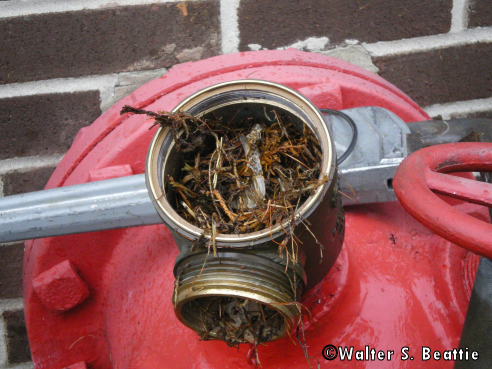
Fire Pump Hose Header Bird Nest

September 22, 2010

Bird's next in Fire Pump Hose Header

I recommend that the bottom valve of a hose header be left open just enough to drain water, but not open far enough for critters to make a home.